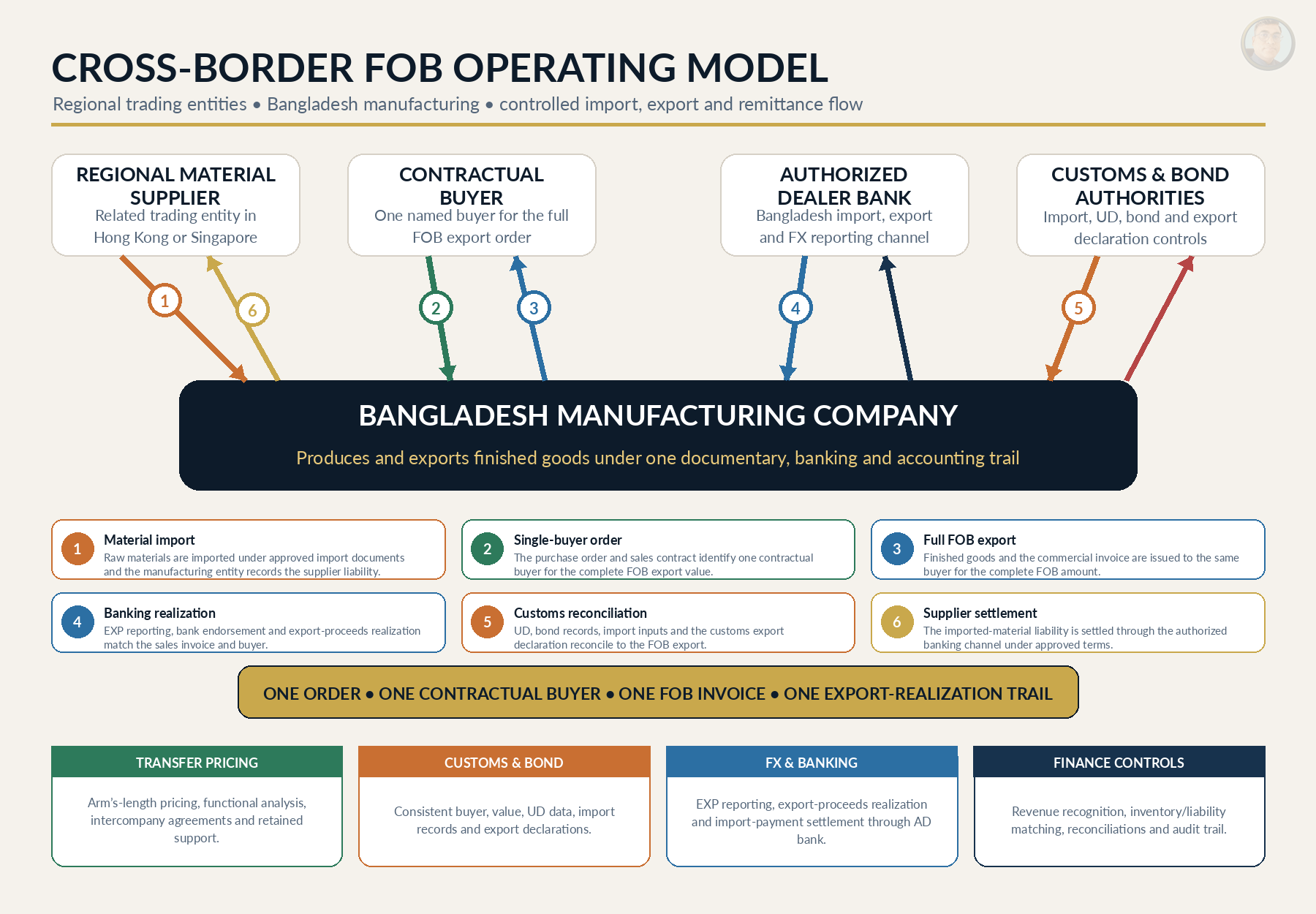
This project addressed a practical cross-border business-model problem: the trading and commercial functions were located in Hong Kong and Singapore, while manufacturing, import processing and export execution were performed in Bangladesh. The objective was to establish a smooth FOB operating flow that management, finance, commercial, customs, tax and banking teams could follow consistently.
1. Business context
The regional trading companies performed commercial and supply-chain functions, while the Bangladesh entity imported materials, manufactured finished garments and completed the physical export. The operating model therefore had to connect four different regulatory and control environments:
- the commercial relationship with the ultimate buyer;
- the material-purchase relationship with a regional supplier;
- Bangladesh customs, bonded-warehouse and export-document requirements; and
- foreign-exchange reporting, export-proceeds realization and import-payment settlement through the authorized dealer bank.
The model also had to preserve a defensible allocation of functions, assets and risks between related entities so that intercompany prices and margins could be supported under transfer-pricing principles.
2. The control problem in the previous flow
The original process treated the CMT portion and the material portion of the same finished-goods order as if they had different buyers. The manufacturing entity shipped one product, but the commercial and remittance trail could point to two counterparties: one for manufacturing value and another for material value.
This created several risks:
- Commercial inconsistency: the purchase order, sales invoice and buyer identity did not represent one complete sale.
- Customs inconsistency: the export value and the buyer shown in the utilization, bond and export documents could differ from the accounting treatment.
- Banking inconsistency: the EXP record and export proceeds could be difficult to reconcile with the full FOB invoice.
- Revenue-recognition risk: the Bangladesh entity could recognize the full FOB value while the contractual evidence was split between counterparties.
- Transfer-pricing risk: related-party functions, pricing and settlement flows were harder to explain and support.
3. Designed end-to-end operating model
| Stage | Designed flow | Primary control |
|---|---|---|
| 1. Commercial order | The regional buyer issues the purchase order to the Bangladesh manufacturer for the complete FOB value. | The same buyer is named in the contract, order and sales invoice. |
| 2. Material import | A regional material supplier provides raw materials to the Bangladesh manufacturer under the approved import and payment route. | Import documents, material value, inventory receipt and supplier liability are reconciled. |
| 3. Manufacturing | The Bangladesh entity converts the imported inputs into finished goods and maintains the required production, utilization and bond records. | Material consumption, output and wastage are traceable to the export order. |
| 4. FOB export | The Bangladesh entity ships the finished goods and issues one commercial invoice to the contractual buyer for the full FOB value. | Invoice, packing list, customs declaration and buyer identity remain consistent. |
| 5. Export realization | The contractual buyer remits the full export proceeds through the authorized dealer bank against the export documentation. | EXP, invoice, shipment, remittance and sales ledger are matched. |
| 6. Import settlement | The Bangladesh entity settles the material-import liability through the authorized banking route according to the approved terms. | Import liability, bank payment and supplier statement are reconciled separately from export revenue. |
4. Transfer-pricing design
Because the trading entities and manufacturing entity may be related parties, the model requires more than documentary alignment. The commercial terms must also reflect the functions performed, assets used and risks assumed by each entity.
The Bangladesh Income Tax Act, 2023 defines international transactions and associated enterprises, requires income and expenditure from international transactions to be determined with regard to the arm’s-length price, and provides for retention of records and submission of an international-transaction statement.
5. Customs, bonded-warehouse and export-document controls
The customs and bond workstream was designed around one reconciliation chain:
Approved input entitlement → material import → inventory receipt → production consumption → finished output → full FOB export value.
For an export-oriented manufacturing operation, the practical control pack may include the applicable import authorization, commercial invoice, packing list, transport/shipping documents, utilization declaration or permission, bond records, customs export declaration and certificate records. The exact documents and procedures depend on the product, facility status and current regulatory instructions.
The project therefore introduced document-level validation of buyer identity, currency, value, quantity, order reference, material consumption and export shipment before the documents were released to customs or the bank.
6. Banking, foreign exchange and remittance flow
The banking design separated the two cash flows:
- Export inflow: the contractual buyer remits the complete FOB sales proceeds to the Bangladesh manufacturer against the export invoice and EXP trail.
- Import outflow: the Bangladesh manufacturer settles the regional material supplier under the approved import-payment mechanism through its authorized dealer bank.
This separation prevents the material supplier from appearing as a second buyer of the finished goods. It also creates a clear audit trail between the sales ledger, export receivable, bank realization, import liability and supplier payment.
7. Finance and accounting control architecture
| Control area | Required evidence | Management purpose |
|---|---|---|
| Sales recognition | Purchase order, contract, full FOB invoice, shipment evidence and buyer receivable. | Ensures the recognized sale represents one complete customer transaction. |
| Material purchase | Supplier invoice, import documents, goods receipt and payable ledger. | Separates imported-material cost from export revenue. |
| Inventory and consumption | Material receipt, bill of materials, production issue, wastage and finished-goods records. | Supports customs/bond accountability and accurate product cost. |
| Export proceeds | EXP data, bank endorsement, remittance advice and receivable clearing. | Confirms full realization against the correct buyer and invoice. |
| Intercompany reconciliation | Buyer, supplier and manufacturer confirmations with aging and settlement status. | Prevents unmatched balances and duplicate or circular recognition. |
| Transfer pricing | Functional analysis, agreements, pricing support and statutory records. | Supports the allocation of profit between regional trading and Bangladesh manufacturing functions. |
8. Governance and implementation
- Mapped the existing order, material, shipping, invoice, EXP, remittance and accounting flows.
- Identified the documentary conflict created by two buyer references for one finished-goods order.
- Selected one contractual buyer for each order and redesigned the commercial and banking documents around the complete FOB value.
- Separated the material-supplier transaction into an import purchase and payable workflow.
- Aligned the transfer-pricing narrative with the actual functions, assets and risks of the regional and Bangladesh entities.
- Created cross-functional checkpoints involving commercial, supply chain, finance, tax, customs/bond and the authorized dealer bank.
- Established monthly reconciliations and an exception log for buyer, value, quantity, invoice, EXP, import liability and remittance mismatches.
9. Business value created
10. Key insights
- A cross-border structure is only as strong as the consistency between the commercial contract, customs declaration, bank reporting and accounting entry.
- A supplier of raw materials is not automatically the buyer of the finished goods; the two contractual roles must be clearly separated.
- Transfer pricing should follow the real operating model, not be prepared after transactions are already recorded.
- The full FOB value should be traceable from order and invoice through shipment, EXP, bank realization and revenue recognition.
- Compliance improves when tax, customs, banking and finance teams design the transaction together rather than reviewing it independently at the end.
Official regulatory reference points
The project framework was reviewed against the following official reference points. Requirements should be revalidated for the specific transaction and implementation date.
- National Board of Revenue — Income Tax Act, 2023 (transfer-pricing provisions, including international transactions, arm’s-length pricing, records and statements).
- National Board of Revenue — Customs Acts (current official Customs Act publications and amendments).
- Bangladesh Bank — Online Export Monitoring System guide (EXP issuing and reporting workflow).
- Bangladesh Trade Portal — import/export process and documentation study (commercial invoice, packing list, EXP and utilization-document references).
Conclusion
This project demonstrates how finance leadership can translate a complex regional trading structure into an executable and controlled business process. By defining one buyer for the complete FOB sale, separating the material-supplier liability and aligning transfer pricing, customs, banking and accounting evidence, the model creates a smoother operating flow for regional trading entities and a Bangladesh manufacturing unit.
The portfolio visual and narrative are deliberately anonymized. They preserve the project logic and management insight without exposing the original companies, brands, banks, counterparties or transaction values.

Written by Liakat Hossain
Finance and accounts professional with experience in FP&A, SAP FICO, Power BI, internal control, reporting, audit, tax, VAT and export-oriented business operations.
This article is original educational content based on professional finance practice. Real-project examples are anonymized, and scenario figures are identified as model outputs rather than guaranteed results.